

Natural and synthetic fragrance oils – what's the difference?
We are often asked if our fragrance oils are natural, and the answer is more nuanced than a simple yes or no. Fragrance oils can be divided into essential (natural) oils and synthetic fragrance oils, and both have their unique properties and uses.
High-quality fragrance oils from European perfume houses
All our fragrance oils are produced by renowned perfume houses in Europe, with a particular focus on Grasse in France – internationally known as the perfume capital. Here, traditional craftsmanship is combined with modern perfumery techniques to create high-quality scents.

Synthetic fragrance oils
Synthetic fragrance oils are a mixture of many different components, many of which originate from natural raw materials such as spices, bark, plants
etc. The fragrance oils are manufactured to be suitable as room fragrances and should be gentle on humans and animals that come into contact with the product. These oils are designed to have good diffusion in the room and to have a soft and pleasant character. These oils are offered in an infinitely wide selection and price ranges.
Synthetic fragrance oils are produced in laboratories and consist of a combination of natural and synthetic ingredients. They are used to create stable, complex, and unique scent profiles that are not always possible to achieve with natural raw materials alone. This is an advanced craft that enables a wide range of fragrances.

Natural essential oils – concentrated fragrance oils from the plant kingdom
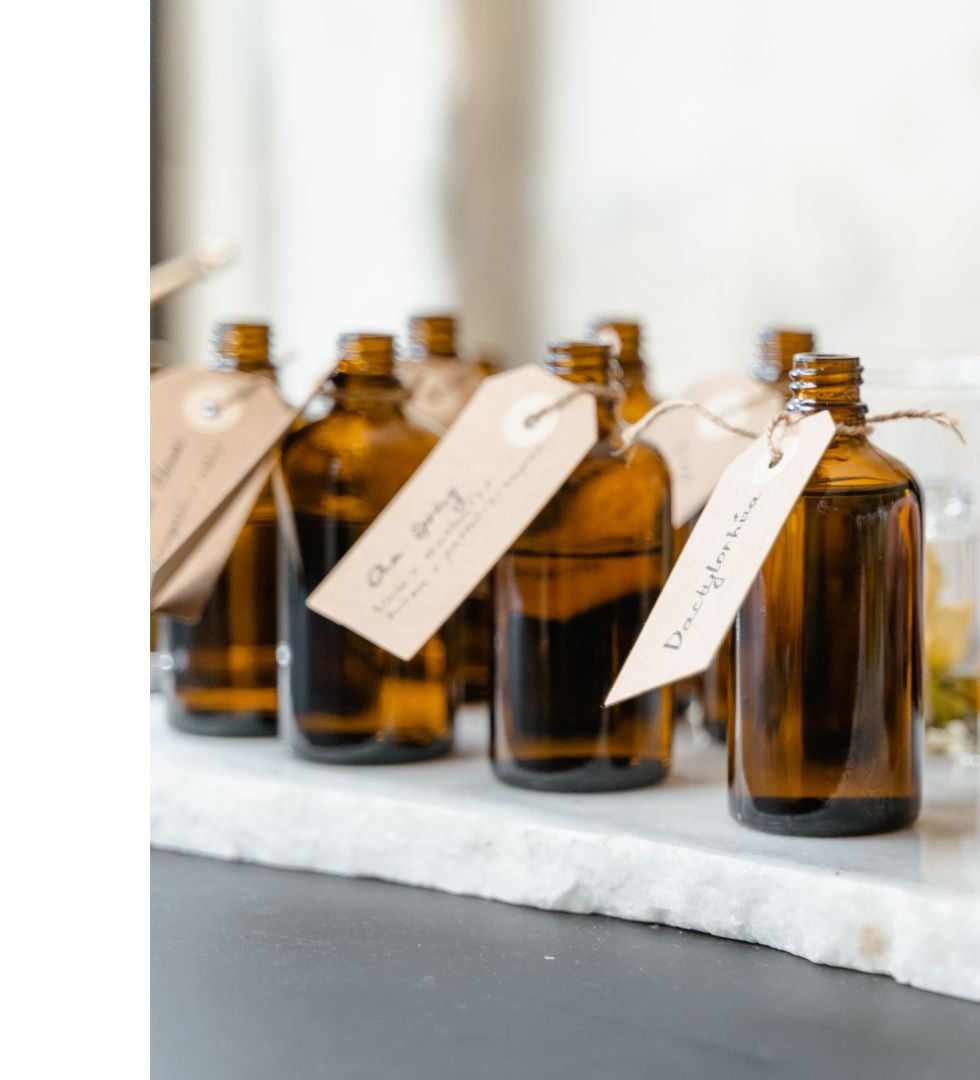
Essential oils are natural, highly concentrated extracts obtained from plants such as spices, flowers, fruits, and herbs. They are used both as fragrances and in aromatherapy due to their characteristic and powerful scent properties.
We offer a carefully selected range of essential fragrance oils, including:
- Lemon Balm
- Lemongrass
- Rose
- Lavender
How essential oils are produced
Essential oils are primarily produced through distillation of plant material, an extensive and time-consuming process. The oil droplets are naturally found in the plant's flower, stem, fruit, or root, and large quantities of plant parts are required to extract a small amount of oil. Therefore, 100% essential oils are both powerful and exclusive.
The water that remains after distillation is called hydrosol or floral water. Hydrosol is often used as a milder fragrance alternative or as an ingredient in skin and beauty products.
Use and precautions
Since essential oils are highly concentrated – often several hundred times stronger than the plant they are extracted from – they should always be used with caution. In sensitive individuals, essential oils can cause allergic reactions.
Essential oils are volatile, meaning they release scent through vapors. They are used, among other methods, through:
- Inhalation of vapors in hot water
- Scent stones
- Reed diffusers, where the oil is diluted with a neutral carrier oil
Absolutes and Resinoids
Absolutes and resinoids contain approximately 85–95% of the same aromatic compounds as essential oils, but are extracted using extraction solvents. These aromatic compounds are generally less volatile than essential oils and are often used in perfumery to create deeper and more long-lasting scent profiles.
Safety, labeling and legislation for fragrance oils
All fragrance oils are classified as chemicals and are subject to current legislation from the Swedish Chemicals Agency and the CLP Regulation (Classification, Labelling and Packaging). This means that each product must be correctly labelled with:
- Full ingredient list
- Clear warning pictograms
- Prescribed safety information
Our responsibility – fragrance oils with care
At The Friendly Home, we have a clear policy to choose fragrance oils that are gentle on both people and the environment. As a basic requirement, we only select fragrance oils that meet our high standards for safety, quality, and sustainability.
Despite careful selection, we cannot guarantee that all individuals will tolerate all fragrances. Sensitive individuals may react differently to certain ingredients, which is important to be aware of when using fragrance products.
Registration and UFI codes
All our products are registered with UFI codes with the European Chemicals Agency ECHA (European Chemicals Agency). This registration ensures that correct information is available to poison control centers within the EU, which is an important part of our safety work.